

Which Group Of Organisms Is It Believed That Animals Evolved From?
27.iv: The Evolutionary History of the Beast Kingdom
- Page ID
- 1966
Skills to Develop
- Depict the features that characterized the earliest animals and when they appeared on earth
- Explain the significance of the Cambrian period for brute evolution and the changes in animal diversity that took place during that time
- Describe some of the unresolved questions surrounding the Cambrian explosion
- Discuss the implications of mass creature extinctions that have occurred in evolutionary history
Many questions regarding the origins and evolutionary history of the animal kingdom continue to be researched and debated, as new fossil and molecular prove change prevailing theories. Some of these questions include the following: How long have animals existed on Earth? What were the earliest members of the beast kingdom, and what organism was their common ancestor? While animal diversity increased during the Cambrian menses of the Paleozoic era, 530 million years agone, modern fossil evidence suggests that primitive animal species existed much earlier.
Pre-Cambrian Animal Life
The time earlier the Cambrian period is known every bit the Ediacaran period (from nearly 635 million years agone to 543 million years ago), the last period of the late Proterozoic Neoproterozoic Era (Figure \(\PageIndex{1}\)). It is believed that early on beast life, termed Ediacaran biota, evolved from protists at this time. Some protest species called choanoflagellates closely resemble the choanocyte cells in the simplest animals, sponges. In addition to their morphological similarity, molecular analyses take revealed like sequence homologies in their DNA.
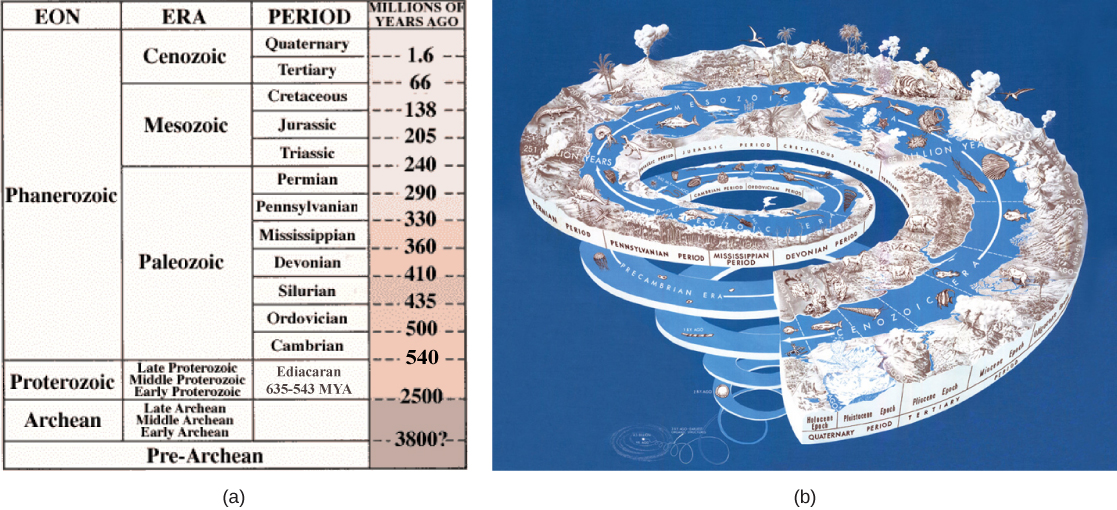
The earliest life comprising Ediacaran biota was long believed to include but tiny, sessile, soft-bodied body of water creatures. However, recently there has been increasing scientific testify suggesting that more varied and complex fauna species lived during this time, and possibly fifty-fifty before the Ediacaran period.
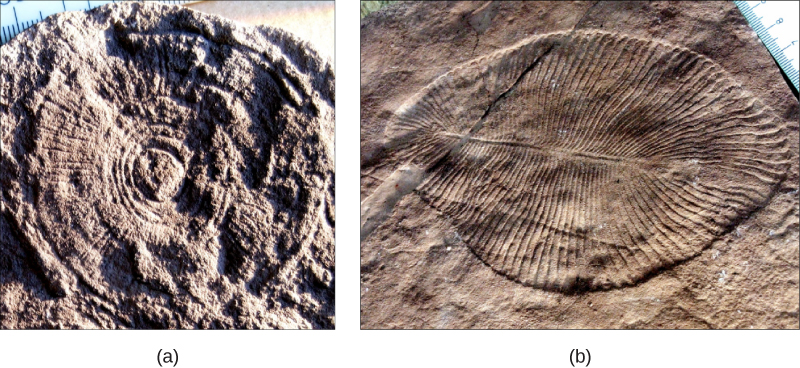
Fossils believed to represent the oldest animals with hard body parts were recently discovered in South Commonwealth of australia. These sponge-like fossils, named Coronacollina acula, date back as far as 560 million years, and are believed to show the being of difficult body parts and spicules that extended 20–forty cm from the primary trunk (estimated about five cm long). Other fossils from the Ediacaran period are shown in Figure \(\PageIndex{ii}\).
Another recent fossil discovery may represent the earliest beast species ever found. While the validity of this claim is still under investigation, these primitive fossils appear to be small, one-centimeter long, sponge-like creatures. These fossils from South Commonwealth of australia date back 650 million years, actually placing the putative animal before the great ice age extinction event that marked the transition between the Cryogenian menses and the Ediacaran period. Until this discovery, most scientists believed that there was no animate being life prior to the Ediacaran period. Many scientists now believe that animals may in fact take evolved during the Cryogenian period.
The Cambrian Explosion of Animate being Life
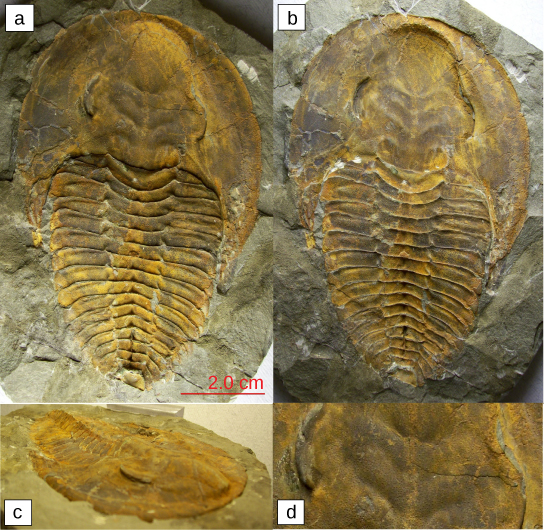
The Cambrian period, occurring between approximately 542–488 million years ago, marks the most rapid development of new animal phyla and animal diversity in World's history. It is believed that most of the animal phyla in being today had their origins during this fourth dimension, oft referred to as the Cambrian explosion (Figure 27.4.3). Echinoderms, mollusks, worms, arthropods, and chordates arose during this period. I of the most dominant species during the Cambrian period was the trilobite, an arthropod that was amongst the commencement animals to showroom a sense of vision (Figure \(\PageIndex{iv}\)).
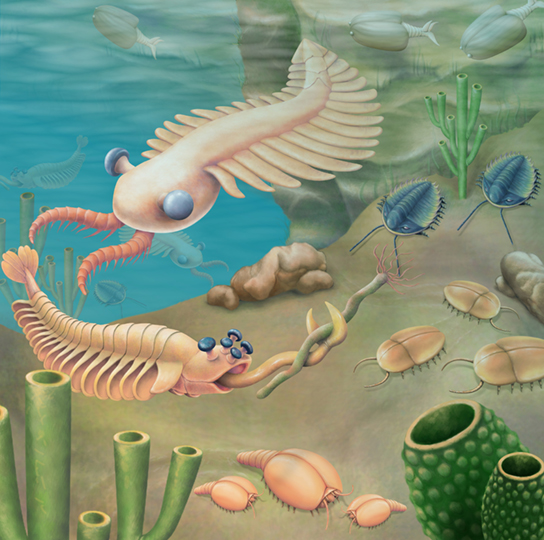
The cause of the Cambrian explosion is still debated. There are many theories that attempt to answer this question. Environmental changes may have created a more suitable environment for animal life. Examples of these changes include ascent atmospheric oxygen levels and large increases in oceanic calcium concentrations that preceded the Cambrian menstruum (Figure \(\PageIndex{v}\)). Some scientists believe that an expansive, continental shelf with numerous shallow lagoons or pools provided the necessary living space for larger numbers of unlike types of animals to co-be. At that place is also support for theories that fence that ecological relationships between species, such as changes in the food web, competition for food and space, and predator-casualty relationships, were primed to promote a sudden massive coevolution of species. Yet other theories claim genetic and developmental reasons for the Cambrian explosion. The morphological flexibility and complication of beast development afforded past the development of Hox command genes may have provided the necessary opportunities for increases in possible animal morphologies at the time of the Cambrian period. Theories that try to explain why the Cambrian explosion happened must be able to provide valid reasons for the massive animal diversification, also as explain why it happened when it did. At that place is testify that both supports and refutes each of the theories described above, and the answer may very well be a combination of these and other theories.
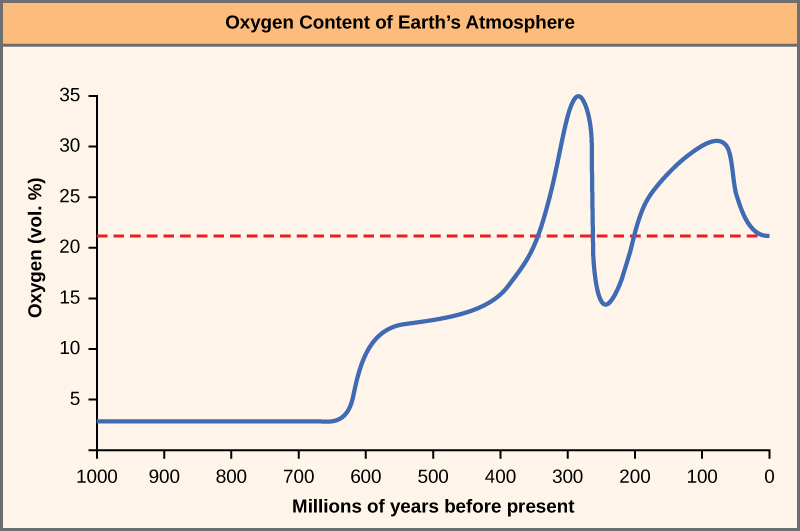
Nevertheless, unresolved questions about the fauna diversification that took place during the Cambrian menstruum remain. For example, we do not understand how the evolution of then many species occurred in such a short menstruum of time. Was there really an "explosion" of life at this particular time? Some scientists question the validity of the this idea, because at that place is increasing evidence to advise that more animal life existed prior to the Cambrian period and that other similar species' so-called explosions (or radiations) occurred later in history also. Furthermore, the vast diversification of animate being species that appears to have begun during the Cambrian catamenia continued well into the following Ordovician catamenia. Despite some of these arguments, most scientists agree that the Cambrian period marked a time of impressively rapid brute evolution and diversification that is unmatched elsewhere during history.
Link to Learning
View an animation of what ocean life may have been similar during the Cambrian explosion.
Mail-Cambrian Evolution and Mass Extinctions
The periods that followed the Cambrian during the Paleozoic Era are marked past further animal evolution and the emergence of many new orders, families, and species. As animal phyla continued to diversify, new species adapted to new ecological niches. During the Ordovician period, which followed the Cambrian period, plant life first appeared on land. This change allowed formerly aquatic animal species to invade land, feeding directly on plants or decaying vegetation. Continual changes in temperature and wet throughout the remainder of the Paleozoic Era due to continental plate movements encouraged the evolution of new adaptations to terrestrial beingness in animals, such as limbed appendages in amphibians and epidermal scales in reptiles.
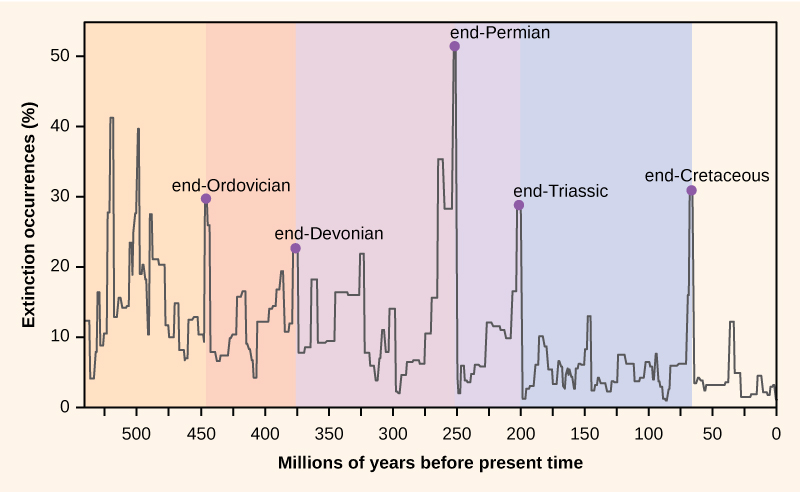
Changes in the environment often create new niches (living spaces) that contribute to rapid speciation and increased diversity. On the other hand, cataclysmic events, such as volcanic eruptions and shooting star strikes that obliterate life, can result in devastating losses of diversity. Such periods of mass extinction (Effigy \(\PageIndex{6}\)) accept occurred repeatedly in the evolutionary record of life, erasing some genetic lines while creating room for others to evolve into the empty niches left behind. The end of the Permian period (and the Paleozoic Era) was marked past the largest mass extinction issue in Globe's history, a loss of roughly 95 percent of the extant species at that time. Some of the dominant phyla in the world'due south oceans, such as the trilobites, disappeared completely. On country, the disappearance of some dominant species of Permian reptiles made it possible for a new line of reptiles to sally, the dinosaurs. The warm and stable climatic conditions of the ensuing Mesozoic Era promoted an explosive diversification of dinosaurs into every conceivable niche in land, air, and water. Plants, too, radiated into new landscapes and empty niches, creating complex communities of producers and consumers, some of which became very large on the abundant food available.
Another mass extinction result occurred at the cease of the Cretaceous period, bringing the Mesozoic Era to an end. Skies darkened and temperatures fell as a large falling star impact and tons of volcanic ash blocked incoming sunlight. Plants died, herbivores and carnivores starved, and the mostly cold-blooded dinosaurs ceded their dominance of the landscape to more warm-blooded mammals. In the post-obit Cenozoic Era, mammals radiated into terrestrial and aquatic niches once occupied by dinosaurs, and birds, the warm-blooded offshoots of one line of the ruling reptiles, became aerial specialists. The advent and dominance of flowering plants in the Cenozoic Era created new niches for insects, as well equally for birds and mammals. Changes in beast species variety during the late Cretaceous and early on Cenozoic were besides promoted by a dramatic shift in Globe's geography, as continental plates slid over the crust into their current positions, leaving some animal groups isolated on islands and continents, or separated by mountain ranges or inland seas from other competitors. Early in the Cenozoic, new ecosystems appeared, with the evolution of grasses and coral reefs. Belatedly in the Cenozoic, further extinctions followed past speciation occurred during ice ages that covered loftier latitudes with ice so retreated, leaving new open up spaces for colonization.
Link to Learning

Lookout man the following video to learn more about the mass extinctions.
Career Connection: Paleontologist
Natural history museums contain the fossil casts of extinct animals and information nigh how these animals evolved, lived, and died. Paleontogists are scientists who study prehistoric life. They use fossils to observe and explain how life evolved on Globe and how species interacted with each other and with the surroundings. A paleontologist needs to be knowledgeable in biological science, ecology, chemistry, geology, and many other scientific disciplines. A paleontologist's work may involve field studies: searching for and studying fossils. In addition to digging for and finding fossils, paleontologists also prepare fossils for further study and analysis. Although dinosaurs are probably the showtime animals that come to listen when thinking about paleontology, paleontologists study everything from found life, fungi, and fish to ocean animals and birds.
An undergraduate degree in earth science or biology is a proficient place to start toward the career path of becoming a paleontologist. Most frequently, a graduate degree is necessary. Additionally, work feel in a museum or in a paleontology lab is useful.
Summary
The almost rapid diversification and development of animal species in all of history occurred during the Cambrian catamenia of the Paleozoic Era, a miracle known every bit the Cambrian explosion. Until recently, scientists believed that there were only very few tiny and simplistic brute species in existence earlier this menstruum. However, recent fossil discoveries take revealed that additional, larger, and more complex animals existed during the Ediacaran period, and even possibly earlier, during the Cryogenian period. Even so, the Cambrian menstruum undoubtedly witnessed the emergence of the bulk of creature phyla that we know today, although many questions remain unresolved almost this historical phenomenon.
The residual of the Paleozoic Era is marked by the growing appearance of new classes, families, and species, and the early colonization of land by certain marine animals. The evolutionary history of animals is too marked by numerous major extinction events, each of which wiped out a majority of extant species. Some species of most animal phyla survived these extinctions, allowing the phyla to persist and go on to evolve into species that we see today.
Glossary
- Cambrian explosion
- fourth dimension during the Cambrian period (542–488 million years ago) when virtually of the creature phyla in beingness today evolved
- Cryogenian flow
- geologic period (850–630 million years ago) characterized by a very cold global climate
- Ediacaran period
- geological period (630–542 one thousand thousand years ago) when the oldest definite multicellular organisms with tissues evolved
- mass extinction
- event that wipes out the majority of species within a relatively curt geological time period
Source: https://bio.libretexts.org/Bookshelves/Introductory_and_General_Biology/Book:_General_Biology_%28OpenStax%29/5:_Biological_Diversity/27:_Introduction_to_Animal_Diversity/27.4:_The_Evolutionary_History_of_the_Animal_Kingdom
Posted by: hollandthomfor.blogspot.com
0 Response to "Which Group Of Organisms Is It Believed That Animals Evolved From?"
Post a Comment