

What Animals Use The Wild Spotted Geranium For Food
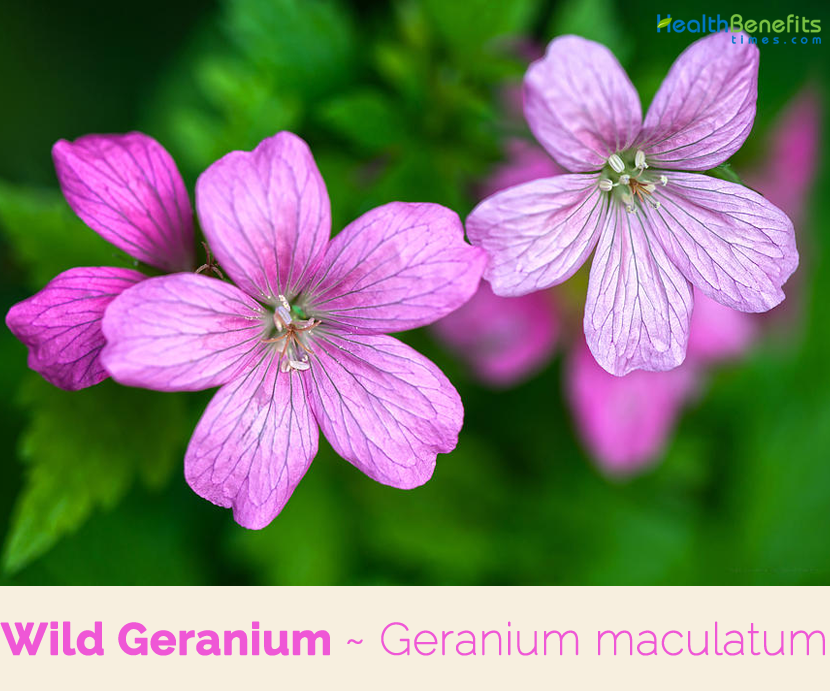
| Wild Geranium Quick Facts | |
|---|---|
| Proper noun: | Wild Geranium |
| Scientific Name: | Geranium maculatum |
| Origin | Eastern North America, all the style from Manitoba and Quebec |
| Colors | Dark-brown |
| Shapes | Beak-like pod about ane inch long. As it matures, the carpels retract and the tiny seed are expelled abroad from the female parent establish. |
| Taste | Sour, bitter |
| Health benefits | Beneficial for diarrhea, Canker sores, dysentery, irritable bowel syndrome, cholera, kidney complaints, bleeding, tonsillitis and toothaches |
Geranium maculatum commonly known as Wild Geranium is a dodder-forming woodland perennial institute from the genus Geranium and belongs to the Geraniaceae family unit. The plant is native to eastern North America, all the fashion from Manitoba and Quebec to Alabama and west to Oklahoma and South Dakota. Apart from wild geranium the plant is too known as spotted Cranesbill, spotted geranium, crowfoot, cranesbill, wild crane's-bill, American cranesbill, alumroot, alum flower, storks neb, chocolate bloom, onetime Maid'southward Night Cap, rockweed, crewman's Knot and shame face up.
Geranium is derived from the Greek word geranos, which means crane. Though this name seems questioning, it really refers to the shape of the seed pod, non the flower. Papery seed capsules, which separate lengthwise into five long peels, await similar a crane or stork. Cranesbill and Storksbill are two other common names of Wild Geranium describing this likeness. Maculatum, the species name, means mottled and refers to the dark greenish- brown leaves which are rather mottled. Still we telephone call this flower Wild Geranium, "wild" is truly a contradiction. Wild Geranium is really a true geranium. The term wild is used to differentiate this blossom from other false species.
Plant Description
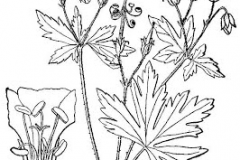
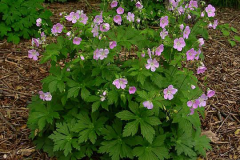
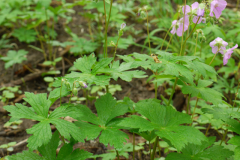
Wild germanium is a moulding rhizomatous, clump-forming herbaceous perennial ground cover that grows about 2 feet (60 cm) tall and 18 inches (45 cm) broad. The institute is found growing in woodland areas, thickets, moisture or damp places, in swamps, marshes, moist woodlands, mesic deciduous wood, alluvial forests, upland woods, savannas, meadows, shaded seeps, rocky glades and moist prairies from side by side woods. The found is easily grown in moist, average, medium, well-drained humusy soil in full sun to role shade. Plants normally tolerate loamy, sandy or poor infertile soils, acidic pH, brusque term drought and total sun if acceptable wet is nowadays. The plant has creeping roots that are woody, knotty, and most 1 inch thick, with creamy white centers. Rhizomes are long, and 5 to ten cm (2 to iv in) thick, with numerous branches. It is covered with scars, showing the remains of stems of previous year's growth. When dry information technology has a somewhat purplish color internally.
Leaves
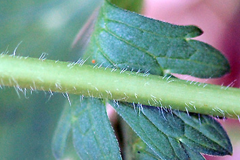
The leaves are semi evergreen, opposite, palmately lobed with five or seven deeply cutting lobes, x–12.5 cm (4–5 in) broad, with a petiole upwards to 30 cm (12 in) long and pubescent with green to reddish colour arising from the rootstock. They are deeply parted into iii or 5 divisions, each of which is again cleft and toothed. The leaf margin is irregularly and coarsely toothed or cleft all around. Foliage surface is medium greenish and pubescent. Lower leafage surface has coarse white hairs like those on the petiole while the upper surface is covered with fine white hairs.
Flowers
The upturned flowers are borne at the top of hairy stems in loose clusters of 2-5 (a corymb or floppy umbel). Each 2.v–iv cm (1.0–1.6 in) diameter flower has v rounded petals, five green sepals and ten yellowish stamens surrounding the unmarried pistil with five carpels. The petals are generally rose-pink to lavender, only may exist darker majestic or rarely white, with fine, slightly darker-colored lines running forth their length that role as nectar guides. The petals are marked with darker lines along the length, and oftentimes fade to white at the base. The 5 dark-green sepals behind the flower are most half as long as the petals, and hairy. In the Northern Hemisphere, they appear from April to June (precise dates depend on the latitude).
Fruits
Flowers are followed by an erect neb-like seed capsule, covered with pilus, develops at maturity. The sheathing has five cells, each containing one seed and when mature, the outer carpels of the capsule ringlet backward to expose the seeds. The central stem so extends upwards raising the 5 seeds, each then uncoiling its ain spring-similar stalk, with the remnants of the style held in a higher place them. The entire contraption resembles a wrought fe chandelier with five lamps. Each seed has long hairs fastened and the coiled stalks have very short hairs.
 Closer-view-of-bloom.-of-Wild-Geranium-png
 Flowering-buds-of-Wild-Geranium
 Flower-of-Wild-Geranium
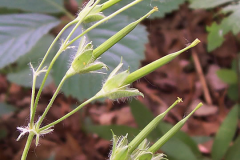 Immature-fruit-of-Wild-Geranium
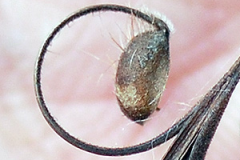 Individual-seed-with-fine-surface-hair-of-Wild-Geranium
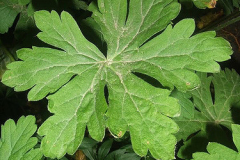 Leaves-of-Wild-Geranium
 Plant-Illustration-of-Wild-Geranium
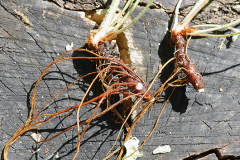 Root-organization-with-long-thin-rhizomes
 Sketch-of-Wild-Geranium
 Stem-of-Wild-Geranium
 Wild-Geranium-establish
 Wild-Geranium-Constitute-growing-wild
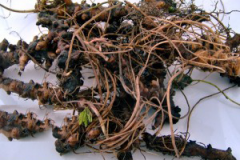 Wild-Geranium-Root-Nerveless
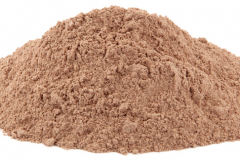 Wild-Geranium-root-pulverization
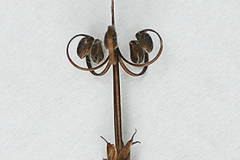 Wild-Geranium-Seedhead-at-full-maturity
Health benefits of Wild Geranium
Few of the well known health benefits of Wild geranium are mentioned beneath
i. Canker Sores
Wild Geranium is an astringent herb that tin can be used as a mouth rinse to soothe the pain of canker sores. The herb consists of good amount of tannins that can bind upward fluids and possibly relieve inflammation. They are used as a rima oris rinse and and then are spit out.
Diarrhea
Wild Geranium has been used by several North American indigenous tribes to care for diarrhea. The tannins in cranesbill likely account for the anti-diarrheal activeness.
It has been used by several of the indigenous tribes of North America to treat diarrhea. The tannins in Wild Geranium probable business relationship for the anti-diarrheal action—although there has been little scientific research to clarify Wild Geranium'south constituents and actions.
Traditional uses and benefits of Wild Geranium
- Whole plant, only specially the root, is antiseptic, highly astringent, diuretic, styptic and tonic.
- An infusion of the whole constitute, or of the roots lone, is used in the treatment of diarrhea, dysentery, irritable bowel syndrome, cholera, kidney complaints, bleeding and a wide range of other ailments.
- Externally, it is practical to purulent wounds, hemorrhoids, thrush, vaginal discharges and inflammations of the oral fissure.
- Root and rhizome of Wild Geranium plant is used in herbal medicine.
- Powdered form of root is used to heal Wounds and Swollen feet.
- Fresh leaves are used to treat Insect stings and equally a Mosquito repellent.
- Cranesbill is used to stop aberrant bleeding related to Catamenia and Uterine problems.
- It can be used as a Mouthwash or gargle for mouth and throat inflammation, tonsillitis and toothaches.
- It is effective confronting bacteria causing Tuberculosis.
- Wild geranium is a woodland herb whose roots tin exist gathered for the herbal apothecary as a helpful remedy for an upset tum.
- Leaf tea is a good drinkable to sip to soothe a sour or upset stomach.
- Leaves can also be used as an astringent mouthwash or equally a topical field medicine to wash wet, weepy rashes and wounds, common foragers' ailments.
- Information technology was used equally eyewash and the powdered root, often mixed with other herbs, was used as a compress on wounds and bloated feet.
- Ojibwe or Chippewa used the dried and powdered roots (rhizomes) to remedy mouth ulcers, inflamed gums and sore throat.
- Blackfoot tribe used it to end hemorrhages.
- Constitute was later used by the European settlers in North America for diarrhea, internal bleeding, cholera and sexually transmitted diseases.
- It possesses hemostatic properties and can work equally an amanuensis to stop internal hemorrhages.
- Herb is used for hemoptysis, hematuria and heavy menstrual bleeding and externally to finish bleeding and heal wounds.
- The herb can be effective against thrush, inflammation of the mouth and throat, tonsillitis and toothaches.
- Information technology has been plant that it is very active against the bacteria that crusade tuberculosis.
- Chippewa Indians used dried, powdered rhizomes mixed with grape juice every bit a mouthwash for children with thrush.
- Poultice from the base or pounded roots of the establish was used to treat burns and hemorrhoids.
- Boiled root was besides used for toothache and crushed to a paste applied to piles.
- It was used to staunch hemorrhages in the lungs, uterus, bowels and breadbasket every bit well as beingness used for excessive nosebleeds.
- Balm made from the root was applied to runny eyes.
- Root, with cayenne pepper was made into a decoction for typhoid fever and childhood cholera.
- In the 19th century the root was used every bit a remedy for gastric ulcers, to relieve pain and maybe to cure them.
- An infusion of the root was given for kidney troubles and to terminate a heavy menstrual flow and for period irregularities in general.
Ayurvedic Health benefits of Wild Geranium
- Aphthous Ulcers: Launder the ulcers from wild geranium excerpt twice or thrice a mean solar day.
- Diarrhea: Put 1-2 tsp of the wild Geranium rhizomes in a cup of water. Eddy. Simmer for 10-15 minutes. Drink three times a day.
- Gingivitis: Take Catechu, Wild Geranium and Myrrh. Pulverization them. Add together a little clove powder. Use it as a molar pulverisation.
- Swelling: Mix Wild Geranium root powder, Talcum Powder and Phellodendron Amurense bark pulverization gently. Apply the mixed powder locally on the swollen region.
- Dysentery: Set up a decoction of Wild Geranium, Echinacea, Ipecacuanha. Use two-three times a twenty-four hours.
Precautions
- A brown dye is obtained from the flowers.
- The roots and the leaves are rich in tannin.
- Plants are suitable for ground cover when spaced about 45 cm apart each way.
- The fresh leaves tin also exist rubbed on insect stings and used as a musquito repellant.
References:
https://www.itis.gov/servlet/SingleRpt/SingleRpt?search_topic=TSN&search_value=29107#zero
https://davesgarden.com/guides/pf/go/79835/
https://pfaf.org/user/Found.aspx?LatinName=Geranium+maculatum
http://www.missouribotanicalgarden.org/PlantFinder/PlantFinderDetails.aspx?kempercode=c850
https://world wide web.nps.gov/miss/learn/nature/wildgeranium.htm
https://plants.usda.gov/cadre/profile?symbol=gema
http://www.theplantlist.org/tpl/record/kew-2823548
https://en.wikipedia.org/wiki/Geranium_maculatum
https://world wide web.fs.fed.united states/database/feis/plants/forb/germac/all.html
http://world wide web.dec.ny.gov/docs/administration_pdf/0611wildgeranium.pdf
Comments
Source: https://www.healthbenefitstimes.com/wild-geranium/
Posted by: hollandthomfor.blogspot.com
0 Response to "What Animals Use The Wild Spotted Geranium For Food"
Post a Comment